
If back pain, neck pain, or shooting leg pain has started running your life — and you’ve been told surgery may be the only option left — there is a step worth taking first.
Non-surgical spinal decompression is a gentle, FDA-cleared therapy that relieves pressure on damaged discs and pinched nerves. No drugs. No injections. No incisions. No downtime. Most patients lie fully clothed on a comfortable table for about 30 minutes — some fall asleep during treatment.
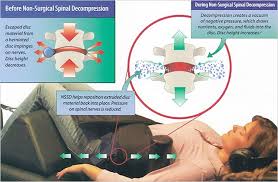
Spinal decompression is a computer-controlled therapy that gently stretches the spine through precisely timed cycles of pull and release. That controlled motion creates negative pressure inside the disc — a vacuum effect.
That vacuum does two things a hot pack and a bottle of ibuprofen never will:
This is not the same as being hooked to a basic traction machine. Ordinary traction pulls; the body’s muscles fight back and guard, and the pull never reaches the disc. Decompression uses computer-monitored sensors to sense that guarding and adjust in real time, so the force actually lands where the problem is.
Both the low back and the neck can be treated. Cervical decompression uses a separate, gentle head-and-neck cradle.
We don’t put anyone on the decompression table on day one without knowing what’s wrong. Here’s the actual sequence:
1. Free consultation. You sit down with Dr. Norman or Dr. Larkin and explain what hurts, when it started, and what you’ve already tried. Roughly 15–20 minutes, no cost, no pressure.
2. Examination and imaging. We perform orthopedic and neurological testing, and take on-site digital X-rays as needed. If you already have an MRI, bring it — it makes the picture far clearer.
3. A straight answer. We tell you whether decompression is likely to help you, what results are realistic in your specific case, roughly how many visits it should take, and exactly what it costs. If your case belongs with a surgeon or another specialist, we say so.
4. Your treatment plan. If you decide to move forward, we build a plan around your condition — decompression paired with the supporting care that makes it hold, such as spinal adjustments, muscle stimulation, cold laser therapy, and targeted rehab exercises.
You stay fully clothed. A padded harness fits around your hips and lower rib cage (or a soft cradle supports your head, for neck treatment). You lie back on a cushioned table, and the computer begins slow, gentle cycles of stretch and release.
Most people describe it as a mild, satisfying pull — closer to a stretch than to any kind of treatment. It should never hurt. You hold a safety switch the entire session and can stop it yourself at any moment. Sessions run about 20–30 minutes, and it’s common enough for patients to doze off that we don’t find it surprising anymore.
You get up and walk out. There’s no recovery period, no restrictions, and no medication to schedule your day around. Many patients come in on a lunch break.
Every spine is different, and anyone who quotes you a number before examining you is guessing.
That said, disc tissue heals slowly, and the research on decompression is built around a course of care rather than a single visit. A typical plan runs over roughly 4–8 weeks, with several visits a week early on and fewer as you improve. Many patients notice a change within the first 4–6 sessions, and the fuller benefit typically comes after completing the full plan.
The number that actually applies to you comes out of your examination — and we give you that number, in writing, before you commit to anything.
Decompression is FDA-cleared and considered very low-risk. The most common side effect is mild muscle soreness in the first week, similar to what you’d feel after starting a new stretching routine.
It is not appropriate for everyone. We do not treat patients who are:
This is exactly why the examination comes first. Screening you out is part of doing this properly.
| Spinal Decompression | Pain Medication | Injections | Back Surgery | |
|---|---|---|---|---|
| Invasive? | No | No | Yes — needle | Yes — incision |
| Addresses the cause? | Yes — disc & nerve pressure | No — masks symptoms | Reduces inflammation only | Yes |
| Downtime | None | None | Hours to days | Weeks to months |
| Typical session | 20–30 minutes | — | Clinic visit | Hospital + rehab |
| Risk profile | Low | Dependency, GI, liver | Infection, temporary relief | Anesthesia, scar tissue, revision surgery |
| Reversible if it doesn’t work? | Yes | Yes | Yes | No |
We believe you should know the number before you’re on the table.
Spinal decompression is priced as a course of care, not per visit, because that’s how it works clinically. Nationally, single sessions run roughly $40–$250, and full programs commonly fall between $1,500 and $6,000 depending on the number of visits and the supporting therapies included.
At Nevada Spine & Disc:
→ Read more: [What Spinal Decompression Costs in Las Vegas]
Nearly two decades in this valley. Dr. Jared L. Norman founded Nevada Spine & Disc in 2007 and has spent that time focused on disc and nerve cases specifically — not a general practice that happens to own a table.
Two doctors, one plan. Dr. Norman and Dr. Larkin both work directly with patients, so you’re seen by a doctor rather than handed off.
We say no when the answer is no. Not everyone who walks in is a candidate. We’d rather refer you out than take your money for a plan that won’t work.
Decompression isn’t the whole plan. Discs re-injure when the surrounding structure stays weak. Your care includes the adjustments, soft tissue work, laser, and rehab that make the result hold.
Everything under one roof. On-site digital X-ray, cold laser therapy, shockwave therapy, PRP and PRF regenerative options, and adjustment and manipulation — no chasing appointments across town.
Recovery support next door. Our sister clinic FrostFit — Suite #102 in the same building — offers whole-body cryotherapy, mild hyperbaric oxygen therapy, and red light therapy that patients frequently pair with decompression care.
Rated 4.7★ across 66+ reviews by Las Vegas patients.
We’re on South Eastern Avenue in southeast Las Vegas (89123), minutes from the 215 Beltway and convenient to:
Henderson · Green Valley · Anthem · Silverado Ranch · Enterprise · Southern Highlands · Seven Hills · Paradise · Spring Valley · Summerlin · North Las Vegas
Hours: Mon, Tue, Thu 8:00 AM – 6:00 PM · Wed, Fri 6:30 AM – 12:00 PM · Sat & Sun closed
No. Nearly all patients describe it as a gentle, comfortable stretch, and many relax completely or fall asleep during the session. You hold a safety switch throughout and can stop treatment yourself at any point.
Traction applies steady pull, which makes your muscles tense up and guard, so the force never reaches the disc. Decompression uses computer-controlled cycles and real-time sensors to work around that guarding, so the pressure change actually happens at the disc.
About 20–30 minutes on the table. Plan for roughly 45 minutes in the office when supporting therapies are included.
No. There’s no downtime and no restrictions afterward. Most patients return straight to work or the gym.
Many patients notice a change within the first 4–6 sessions, though this varies with how long the problem has existed and how severe the disc damage is. Your examination gives us a realistic timeline for your case.
Coverage varies by plan. We verify your benefits before you commit and will tell you exactly what your out-of-pocket cost looks like. Personal injury and workers’ compensation cases are often covered.
If you have hardware in your spine — screws, plates, rods, or cages — decompression is not appropriate. If you had surgery without hardware, you may still be a candidate; the examination will determine that.
Not necessarily. We can begin with an examination and on-site digital X-ray. If you already have an MRI, bring it — it gives us a much clearer picture of the disc.
Decompression addresses the disc compression causing your pain, and results often hold well. Lasting outcomes depend on completing the full plan and maintaining the strength and habits that keep the spine supported — which is why rehab is part of your care.
We’ll tell you at the free consultation and point you toward the care that fits your situation, whether that’s another therapy here or a referral out.
You don’t have to keep planning your life around your back. Find out whether spinal decompression can help you — the consultation costs nothing and commits you to nothing.
📞 Call (702) 492-1776
Nevada Spine & Disc · Serving Las Vegas since 2007